Last Updated on December 15, 2025 by Jane Nriapia
If your clinic website looks great but still isn’t showing up on Google, you’re not alone.
In 2025, ranking isn’t just about keywords or how you plan content strategies for your aesthetics clinic. It’s also about how well your site communicates trust, structure, and relevance to both your patients and to search engines & LLMs.
I’ve looked at a lot of aesthetics clinic websites in my time working in digital marketing, and I’ve noticed a few common issues that come up again and again.
Here are 5 things that might be holding your site back, along with practical tips to help you fix them.
1. Your Homepage Is Missing SEO Signals
Google uses your homepage to understand who you are, where you’re based, and what you offer.
But many aesthetics clinic websites lead with vague slogans, oversized video headers, or generic designs that offer little real SEO value.
It might look good, but if the fundamentals aren’t in place, your homepage won’t attract traffic or convert new patients.
How to fix it:
Include your clinic name, location, core treatments, and a clear headline like: “Expert Aesthetics Clinic in the Heart of Leeds.”

Make it easy for Google and your visitors to understand what you offer and where you’re based.
2. Your Treatment Pages Are Too Thin (or Too Deep)
You might offer fantastic treatments, but if they’re buried three or four clicks deep or hidden behind generic category or conditions pages Google can’t prioritise them.
I’ve seen this first-hand on a site I used to work on: it took four clicks to reach a key treatment, with no logic behind how services were grouped.
The design looked poor across the board and on mobile, it was even worse. The menu collapsed every time you tried to navigate, making it almost impossible for users (or search engines) to find what they needed.

This is where understanding the difference between specialist SEO for aesthetics clinics, CRO (conversion rate optimisation), and UX (user experience) becomes crucial.
SEO gets users to your site, but CRO and UX are what convince them to stay, explore, and book.
If your designer only understands one piece of the puzzle, your clinic’s digital performance will always fall short.
How to fix it:
Create dedicated pages for each of your core treatments like anti-wrinkle injections, dermal fillers, skin boosters, or microneedling.
Try grouping them into categories that make sense for your patients, such as:
- Injectables
- Skin treatments
- Body or laser treatments
This not only improves the user experience, but also helps Google understand the structure of your site and how your treatments relate to each other.
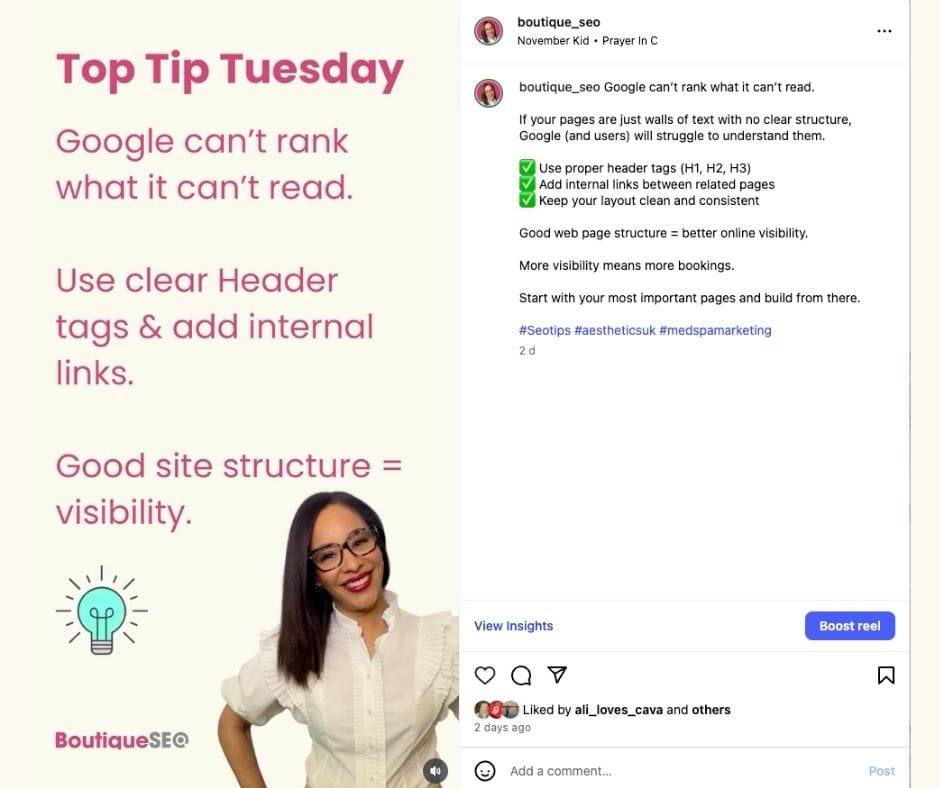
Each treatment page should include:
- Location keywords in your H1 and meta title
- Clear descriptions of the treatment and its benefits
- Patient FAQs
- Before/after placeholders
- Strong internal links to your booking page and related treatments
3. You’re Blogging for Google, Not for Patients
Content like “Causes of Wrinkles” or “All About Skin Concerns” might sound informative, but no one’s searching for them; and they don’t rank.
I’ve worked on plenty of clinic sites where the blog was clearly written just to tick the SEO box, stuffed with keywords, but offering little value to actual patients.
That kind of content doesn’t work anymore.
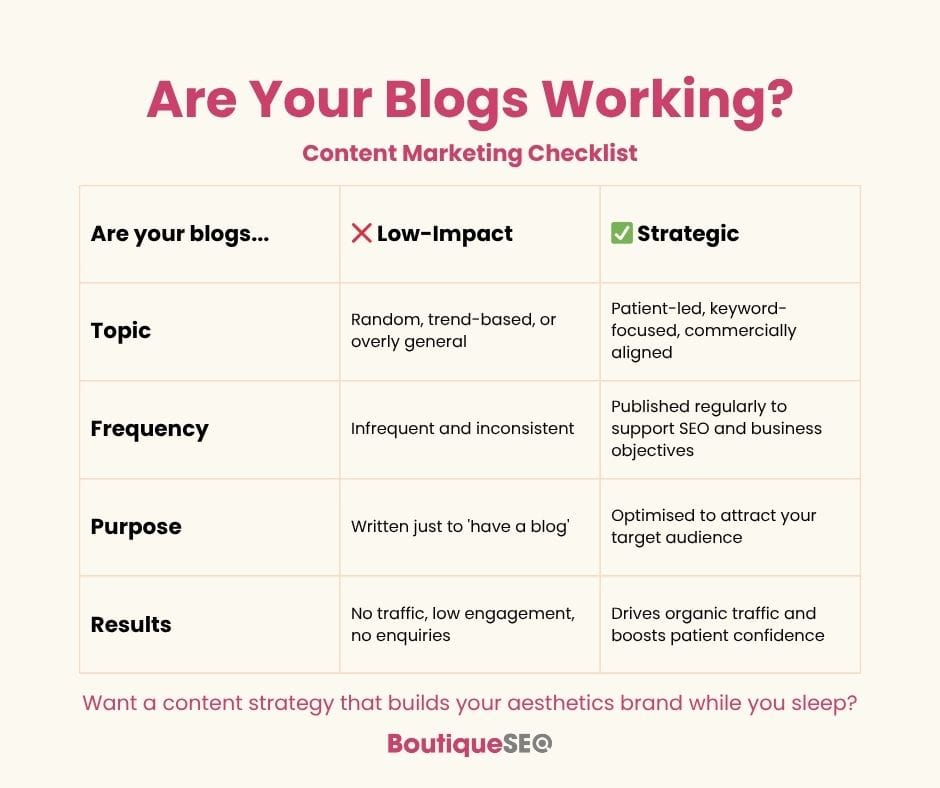
How to fix it:
The purpose of your blog isn’t just to impress Google, it’s to help potential patients make confident, informed decisions.
If you were considering a treatment, what would you want to know? These are the types of things you should be blogging about!
Talk about the treatment experience, recovery time, how long results last, and what real patients have achieved.
Include strong before-and-after images, answer common questions, and link to the service page or booking button.
That’s the kind of content that ranks and converts.
4. You Haven’t Built Trust Signals Into Your Site
Aesthetic SEO isn’t just about ranking, it’s about E-E-A-T (Experience, Expertise, Authoritativeness, Trust).
If your site is missing a strong About page, patient reviews, or team bios with credentials, Google (and users) will move on.
How to fix it:
- Write an About page that explains who you are and why you’re qualified
- Add your GDC/NMC/GMC registration if relevant
- Include real clinic photos and testimonials

5. You’re Not Internally Linking Your Content
Internal linking helps Google discover and prioritise the most important pages on your site but most aesthetic clinics overlook it completely.
If you’ve got a blog post that’s performing well in search, it can pass SEO value (or “link juice”) to other pages that need a boost, such as your core treatment pages.
The same applies to your homepage: it’s usually your highest-authority page, so linking directly from there to your key services can give them a serious SEO lift.
How to fix it:
Review your top-performing pages and make sure they’re linking to the treatments you want to rank for.
Use clear, keyword-rich anchor text for example: “Explore our anti-wrinkle injections in Surrey.”
Think of your internal links as strategic pathways guiding both users and Google to the pages that matter most.
Great places to add internal links include:
- Your homepage (above the fold or in the main menu)
- Blog posts (especially high-traffic or evergreen ones)
- Your About page or Meet the Team section
- The footer (quick links to core services or booking pages)
- Any FAQ or educational pages
Your Next Step to Better SEO
If your clinic site isn’t ranking, it’s rarely one big SEO issue, it’s usually a series of small, fixable ones. And once you know what to look for, it’s easy to take back control of your SEO.
For my full checklist Download my free SEO Playbook for Aesthetic Clinics Or book an SEO audit and I’ll show you exactly where your site’s falling short, and how to fix it.