Last Updated on February 10, 2026 by Jane Nriapia
Google’s AI Mode is now live in the UK, and it’s already changing how patients search for aesthetic treatments.
Traditional SEO signals still matter, but Google is increasingly selecting clinics based on entity understanding, structured information, and clarity of services.
Ranking is no longer enough; to surface in the search engine results pages clinics must now be chosen by AI.
The clinics AI selects get the bookings; while the ones that are left behind are increasingly becoming invisible.
On my recent trip to Glasgow, I decided to search “Botox near me” in AI Mode to see what results surfaced.
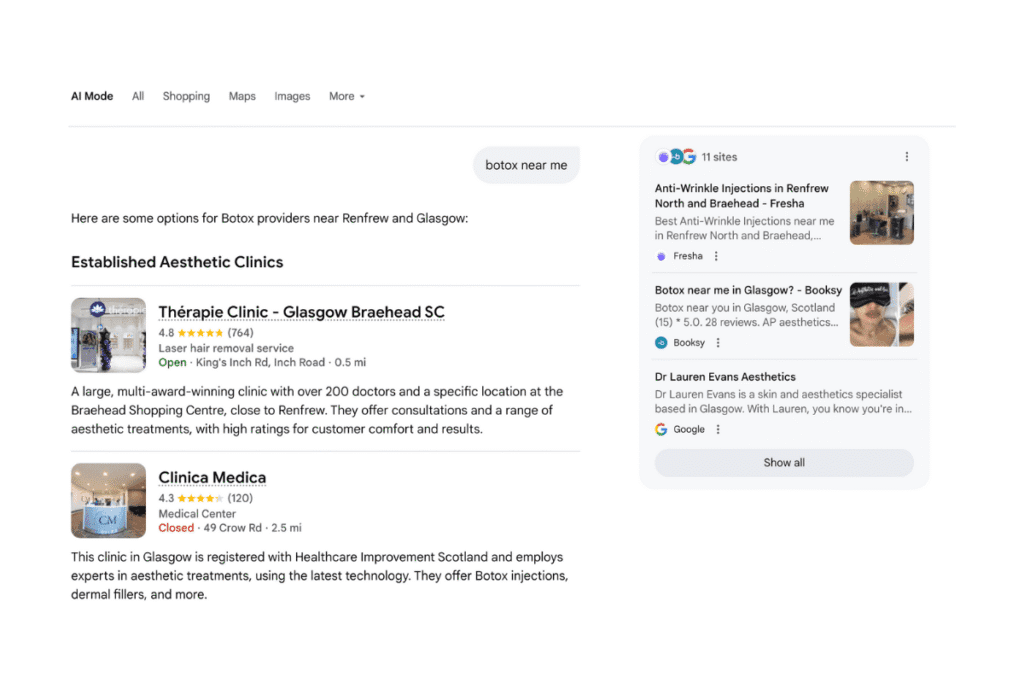
The initial findings were so revealing that I decided to run the same test against two other large UK cities: Leeds and Manchester. The results consistently showed what Google now prioritises and why many UK clinics will disappear from visibility if they don’t adapt.
This blog explains what AI Mode is doing, what it rewards, and the non-negotiable changes aesthetics clinic websites must make to join the AI shortlist.
How is AI Search Impacting Aesthetics Clinic SEO?
When I searched “Botox near me,” AI Mode returned a curated shortlist of clinics with detailed summaries that included:
- Practitioner qualifications
- Regulated status
- Pricing for one, two, and three areas of Botox
- Opening hours and location data
- Key treatment details
- Treatment descriptions such as natural results, medical-grade skincare, and treatment focus
- Clinic accessibility
- Additional medical use cases for Botox such as hyperhidrosis and masseter Botox.
Patients received almost everything they needed without clicking a single website link.
This confirms that AI Mode is functioning as a decision engine rather than a simple search engine. It aggregates clinic data, evaluates credibility, and presents patients with an answer.
The clinics with strong visibility, structured content, and clear service information were the ones that AI Mode surfaced.
The others were ignored entirely.
AI Mode then offered to do a side by side comparison of two clinics of my choosing and created a summary of its key findings:
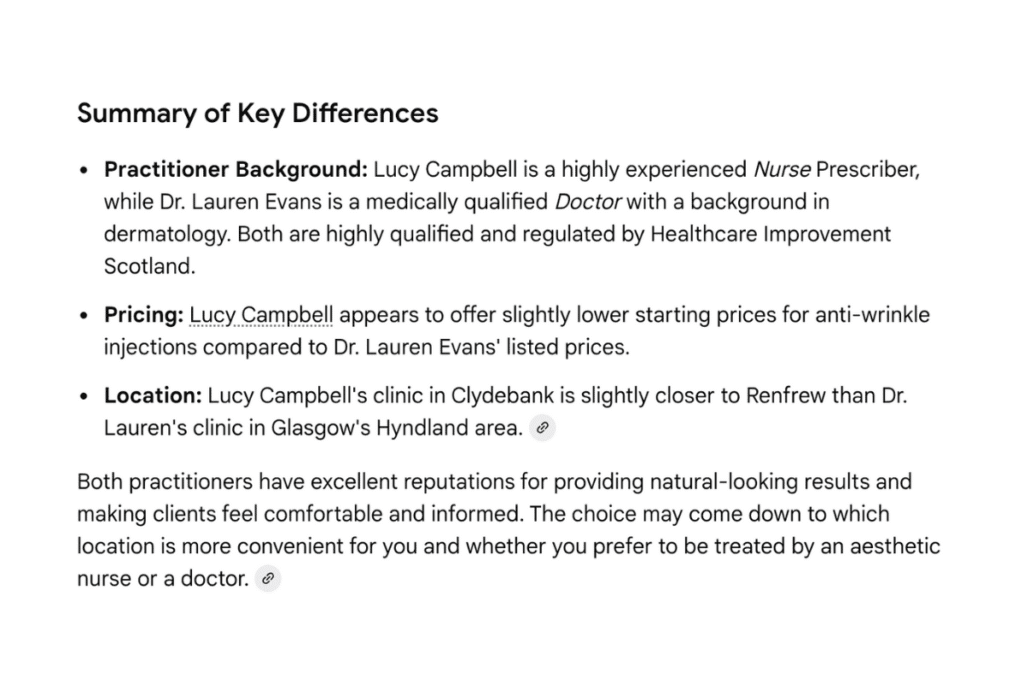
This is the reality of medical aesthetics SEO in late 2025 and as we go into 2026.
Your competitors aren’t just ranking higher anymore. They’re being selected and compared by AI Mode whilst your clinic is being filtered out before patients even see it.
What AI Mode Rewarded in the UK Test
The clinics highlighted by AI Mode across Glasgow, Leeds, and Manchester shared clear characteristics, reinforcing the shift from ranking to selection.
1. Clear Pricing Information (The Case of i.d.LAB)
AI Mode pulled exact treatment prices and specifically referenced this data for local clinics.
- In Glasgow, i.d.LAB was highlighted with a note that states, “They offer specific pricing for 1, 2, or 3 areas of anti-wrinkle injections.”
- In Leeds, clinics like Hannah McCoy Clinic and Face Perfect Clinic were highlighted with links or mentions of their “Price List” availability.
Clinics that provided transparent pricing were featured. If you’re still hiding your prices or making patients call for quotes, AI Mode won’t select you as a preferred answer.
2. Practitioner Entities and Qualifications (The Case of Dr Sknn)
AI highlighted the expertise of the individual providing the treatment, reinforcing the importance of E-E-A-T (Experience, Expertise, Authority, Trustworthiness).
- In Manchester, Dr Sknn was explicitly featured with detailed qualifications: Dr. Eddie Shaffu‘s MB, BCh, BAO, MRCGP, MSc in Skin Ageing and Aesthetic Medicine, and his status as an Associate Member British College of Aesthetic Medicine.
- In Glasgow, Dr Lauren Evans Aesthetics was noted as a “Dermatology Specialty Doctor.”
- In Leeds, multiple clinics were noted as being “Doctor-Led” or having “HCPC-registered team” members.
AI summarised their experience, years in practice, and treatment focus. If you want to excel at being found by AI Mode, you need to share this information semantically on dedicated practitioner or about pages on your website.
3. Regulated Status (The Case of National Chains)
Clinics regulated by local bodies were flagged as trusted providers, immediately boosting their credibility in AI results.
- In Glasgow, Thérapie Clinic and Sculpt Aesthetics Clinic were both explicitly noted as being “registered with Health Improvement Scotland.”
This is a strong entity signal and a clear advantage in clinical search categories. If your website doesn’t clearly convey your regulatory status, you are giving competitors a clear trust signal advantage.
4. Strong Treatment Descriptions and Topical Authority
AI rewarded content depth that connected standard treatments to specific medical and aesthetic use cases.
- In Leeds, Aesthetica Medical was noted for content discussing “How Masseter Botox Can Help Stop Bruxism.”
- Infinity Skin Clinic was highlighted for offering “Sweat Reduction & Hyperhidrosis.”
Clinics with thin or generic content are unlikely to be selected because Google’s AI Mode needs context to be able to surface comprehensive, medically relevant results.
Why Aesthetics Clinics Need Entity-Based Optimisation
Keyword optimisation alone is no longer enough for effective aesthetics digital marketing. AI Mode and SGE (Search Generative Experience) prioritise entities rather than isolated keywords. For clinics, this means Google needs to understand:
- Who you are
- Who provides treatment and What qualifications they hold
- What treatments you offer and What outcomes you specialise in
- Your regulatory status and Your pricing
If Google cannot define your clinic as an entity, you won’t appear in AI Mode, even if you rank well in traditional search. Entity-based optimisation is the future of aesthetics SEO because AI engines favour structured, reliable, and medically accurate data.
How AI Summaries Reduce Traditional Organic Clicks
AI Mode answers patient questions directly. This means fewer clicks to individual aesthetics clinic websites but a higher share of attention for clinics selected by AI.
Information displayed without requiring a click included:
- Prices
- Addresses
- Opening hours
- Practitioner bios
- Treatment descriptions
- Regulatory details
If your competitors provide clear information and structured data for their clinics, they’ll be surfaced. If your clinic uses vague language, hides pricing, or lacks depth, AI won’t select you. The solution isn’t to fight AI.
The solution is to feed AI the information it needs.
The New Aesthetics SEO Blueprint for Clinics in the Age of AI
Here’s what most healthcare marketing agencies won’t tell you: good SEO and optimising for AI Mode aren’t actually different things. The clinics dominating AI Mode results aren’t using some secret GEO or AEO strategy. They’re simply following solid SEO principles that Google has been rewarding for years.
The difference now is that these principles are no longer optional if you want visibility.
1. Publish Clear and Transparent Pricing
AI Mode rewards clinics that present pricing in structured, easy-to-read formats. Pricing tables outperform long paragraphs. If you’re worried about competitors seeing your prices, they already know them. Your patients are the ones being penalised by your secrecy.
2. Build Medically Detailed Treatment Pages
Your treatment pages need to demonstrate genuine medical expertise. Include:
- Treatment explanation and expected results
- Treatment time, longevity, and aftercare
- Medical applications (e.g., hyperhidrosis, bruxism)
- Practitioner expertise and qualifications
3. Create Robust Practitioner Pages
Practitioner entities now directly influence selection. Include:
- Full name, Qualifications, and Years of experience
- Areas of expertise and Photos
- Schema markup for Person entities
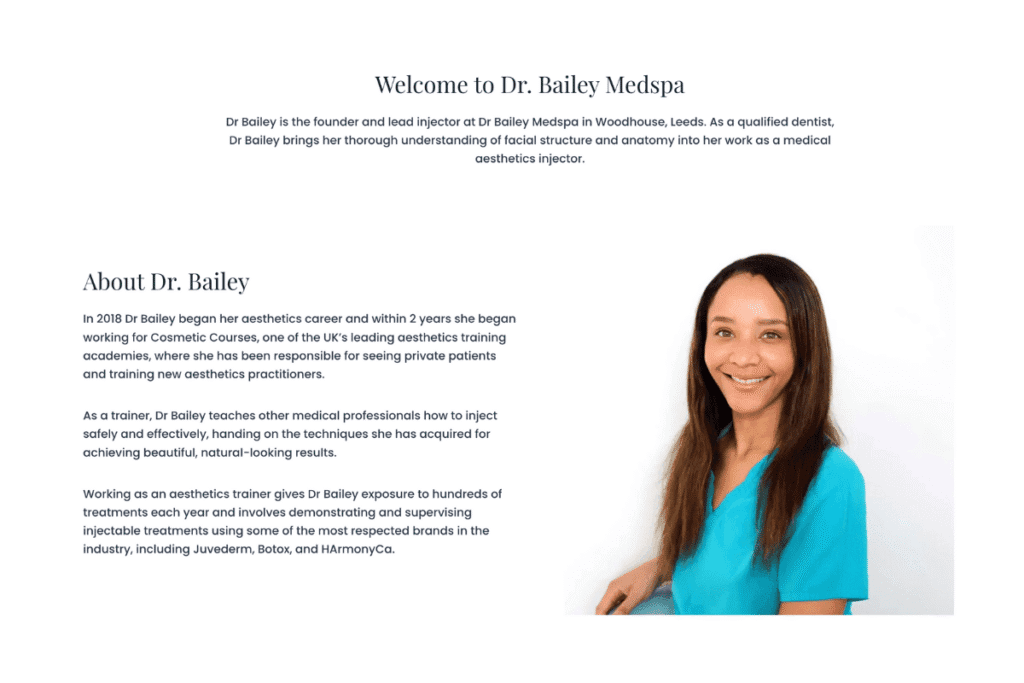
Each injector, prescriber, and therapist needs their own optimised page. This helps AI Mode surface the right information while giving users confidence.
4. Improve Local SEO Fundamentals
Google Business Profile must include:
- Full treatment lists and up-to-date working hours
- Accurate categories and pricing where appropriate
- Consistent patient reviews
AI Mode pulls heavily from GBP data. If your profile is incomplete, you’re unlikely to show up.
5. Add Schema to Strengthen Entity Signals
Use: LocalBusiness, MedicalBusiness, Physician, and Person schema. Schema doesn’t manipulate rankings but strengthens understanding and improves selection in AI results by confirming that your clinic exists, that your practitioners are qualified, and that your treatments are legitimate.
6. Use Internal Linking to Reinforce Relationships
AI wants to understand context, so link:
- Botox pages to masseter, hyperhidrosis, and practitioner pages
- Skin booster pages to blogs about how to achieve healthy skin
This builds a web of meaning that AI Mode follows. Your website structure teaches AI how to understand your clinic.
The Future of Clinic SEO Is AI-Led
AI Mode doesn’t reward the clinic with the nicest interior or most followers. It rewards the clinic Google can understand clearly, verify confidently, and present safely.
Aesthetics SEO is shifting from keywords to clarity, and from ranking to eligibility. Clinics that adopt entity-based optimisation will dominate AI search visibility as this technology becomes the primary search pathway.
The fundamentals haven’t changed but the stakes have. Previously, weak SEO meant ranking on page two. Now it means being completely invisible in AI-powered search.
The clinics that understand this will thrive. The ones that don’t will be wondering how to fill the gaps in their clinic’s diaries whilst wondering why no one is booking treatments via their Instagram page.
The time to adapt is now. Your competitors are being selected by AI right now.
If you’re ready to see exactly what structured data AI Mode can, or cannot, understand about your clinic, contact BoutiqueSEO for a strategic, manual audit of your aesthetics digital marketing.
Don’t wait until the bookings stop!