Last Updated on November 5, 2025 by Jane Nriapia
If you run an aesthetics clinic or work in healthcare marketing, you’ve probably heard of SEO, but knowing how to apply it effectively in the medical aesthetics space is a different story.
This guide will walk you through the essentials of SEO for aesthetics clinics. You’ll learn how to improve your visibility on Google, drive more local enquiries, and avoid the costly mistakes many clinics make with their websites.
Whether you’re a clinic owner trying to understand what your agency is doing, or a marketer looking to sharpen your strategy for a competitive niche, this guide gives you the practical insights you need to get results.
🔗 Jump Links:
- What Is Aesthetics SEO?
- Local SEO for Clinics
- On-Page SEO and Content Strategy
- Off-Page SEO and Trust Signals
- Tracking and Measuring SEO Results
- Common SEO Mistakes Aesthetic Clinics Make
- Should You DIY or Hire an Agency?
- Final Thoughts
Section 1: What Is Aesthetics SEO?
Aesthetics SEO refers to the process of optimising a medical aesthetics clinic’s online presence to appear prominently in organic search results, especially for local treatments like “lip filler in Luton” or “anti-wrinkle injections near me.”
Unlike general SEO, aesthetics SEO operates within strict advertising regulations, YMYL (Your Money or Your Life) content standards, and a highly competitive local search landscape.
It requires balancing medical credibility with marketing finesse, ensuring your site is optimised for both Google and potential patients.
For clinic owners, aesthetics SEO isn’t just about traffic. It’s about visibility in the moments that matter most, when someone nearby is actively searching for the treatments you offer.
For marketers, it’s about structuring a site to support long-term rankings, trust signals (like reviews and accreditations), and conversion-focused content that plays well with Google’s E-E-A-T (Experience, Expertise, Authoritativeness, and Trust) criteria.
A strong aesthetics SEO strategy gives your clinic a sustainable way to attract new patients without relying solely on paid ads or discounts.
With changes like Google Discover now rolling out to desktop, it’s even more important to create content that’s structured for visibility. Read more in our Google Discover update blog.
Section 2: Local SEO for Clinics
Local SEO is the foundation of online visibility for aesthetics clinics. When someone searches for treatments like “lip filler near me” or “anti-wrinkle injections in Sheffield“, your clinic needs to appear in the local results – ideally in the top three listings on Google’s local pack.
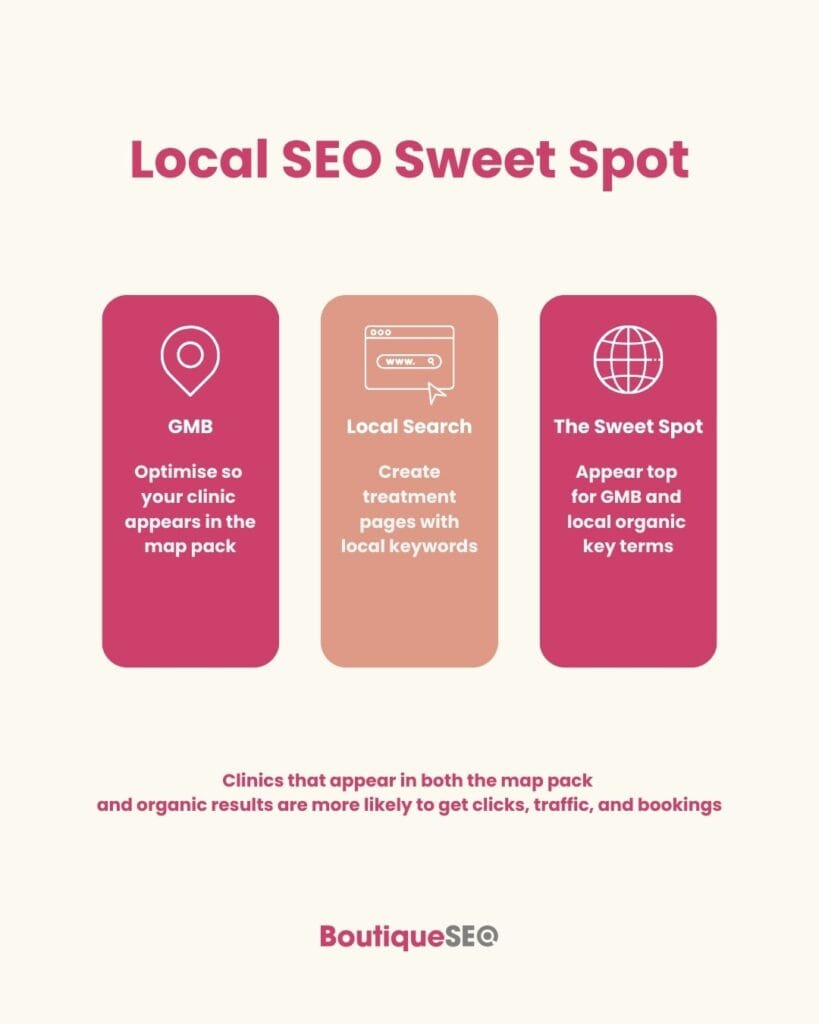
To get there, your site must send strong location signals to Google. That includes optimising your Google Business Profile (GBP), creating locally-relevant website content, and ensuring your contact details are consistent across the web.
Google Business Profile (GBP)
Claiming and optimising your GBP is one of the quickest wins in local SEO. Add accurate information, high-quality images, service categories, and your clinic’s opening hours.
Regularly post updates (even brief ones) and respond to all reviews – both positive and negative.
Clinics often overlook GBP because they think it’s just a directory listing; in reality, it acts as a mini landing page that Google uses to assess trust, relevance, and proximity.
Location-Specific Content
Avoid generic “We serve all areas” messaging. Instead, include location-specific pages or content blocks that mention villages, nearby cities, or landmarks (without keyword stuffing). Write for humans, but make sure search engines can understand where you operate and what services you provide.
If you offer treatments across different branches or regions, create unique location pages that feature tailored content, contact details, and embedded maps. Avoid copying and pasting the same content with a different place name – this approach won’t help you rank and may dilute your site’s authority.
Local Citations and NAP Consistency
Your clinic’s Name, Address, and Phone number (NAP) should be exactly the same everywhere it appears online: website footer, contact page, directory listings, and social media profiles.
Discrepancies confuse search engines and can hurt your local rankings.
Sign up to reputable medical directories (e.g. Save Face or industry-specific associations), make sure your clinic is listed on Google Maps, and check that your NAP info matches exactly. If you’ve moved premises recently, double-check that old details aren’t still listed on third-party sites.
Section 3: On-Page SEO and Content Strategy
Strong on-page SEO is essential for helping Google understand your clinic’s expertise, the treatments you offer, and the locations you serve.
This is where many aesthetics websites fall short: they either under-optimise (thin pages with no substance) or over-optimise (stuffing in keywords unnaturally, or writing content that sounds like it was generated without a clear purpose).
Service Pages vs. Conditions Pages
Every aesthetics clinic should have detailed service pages that explain individual treatments, pricing, benefits, and frequently asked questions.
Avoid creating multiple vague “Conditions We Treat” pages with no treatment-specific content – these often compete with your service pages and dilute your SEO efforts.

Instead, build out robust pages that focus on one core treatment per page (e.g. “Cheek Filler in [Location]”), and include related terms such as target conditions, FAQs, and results timelines in the copy.
Keep the page user-friendly: break up sections with headings, include imagery, and end with a strong call to action.
Choosing the right terms matters – especially for treatments like anti-wrinkle injections, where language affects both SEO and compliance. See our guide to choosing keywords for Botox and anti-wrinkle treatments for examples.
Blog Content and SEO Value
Your blog isn’t just a marketing tool; it’s a crucial part of your SEO strategy. Blogging allows you to answer common patient questions, target long-tail keywords, and demonstrate topical authority – all while driving traffic from search engines.
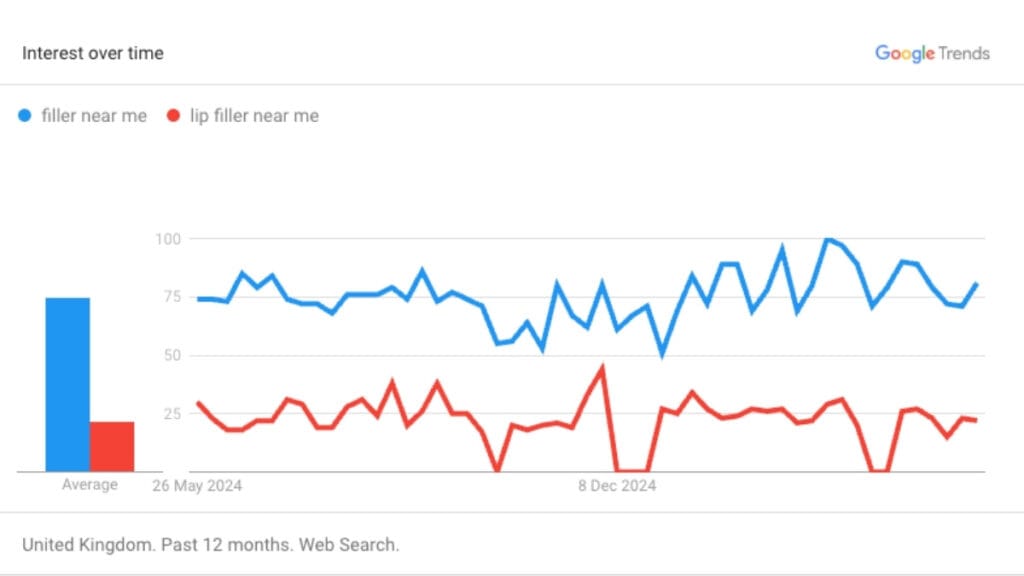
Blog posts should:
- Answer specific search intents (e.g. “How long does Profhilo last?” or “Best treatments for fine lines around the mouth”)
- Be internally linked to relevant treatment pages
- Include keywords naturally (not repeatedly)
- Provide value: real insights, not just filler content
Avoid content for content’s sake. Google has become smarter at detecting low-value, AI-generated, or regurgitated posts.
Focus on clarity, accuracy, and patient relevance.
Google is increasingly integrating AI-generated summaries into search results. Learn how this could impact your clinic in our breakdown of AI Overviews.
Metadata, Headings, and Image Optimisation
Each page on your site should have:
- A clear H1 heading containing your main keyword
- Logical subheadings (H2/H3s) to structure the content
- A well-written meta title and description
- Optimised image file names and alt text
Many clinics skip this step or rely on generic page templates – which is a missed opportunity. -page SEO isn’t hard once you get the basics right, but it does require consistency across the site.
Section 4: Off-Page SEO and Trust Signals
Off-page SEO includes any signals that exist outside of your website but still influence how your clinic ranks in search results. For aesthetics clinics and healthcare providers, trust is everything – and Google uses external signals to assess how reliable, established, and relevant your business is.
Backlinks from Reputable Sources
Backlinks (links from other websites to yours) remain one of the most powerful ranking factors. Quality is more important than quantity: a single link from a reputable medical site can have more impact than dozens of low-quality directory listings.
Aim to earn links from:
- Medical journals or industry publications
- Supplier or product partner websites (e.g. Obagi, Profhilo, Allergan)
- High-quality directories (such as Save Face, Consulting Room, or Private Healthcare UK)
- Local business roundups, lifestyle blogs, or event listings
You don’t need to run a full PR campaign, but reaching out to relevant partners or asking for a link when you’re mentioned can make a measurable difference over time.
Reviews and Reputation Management
Online reviews contribute to both your visibility and your credibility. Regular, authentic reviews on platforms like Google, Trustpilot, and Save Face reinforce your reputation with both search engines and potential patients.
Encourage happy patients to leave a review after treatment, and always respond – especially to negative ones. A thoughtful reply to a poor review can do more for your brand than ignoring it altogether.
E-E-A-T and Author Credentials
E-E-A-T stands for Experience, Expertise, Authoritativeness, and Trust. While it isn’t a direct ranking factor, Google uses these signals to evaluate how reliable your content is – especially for YMYL (Your Money or Your Life) topics like medical aesthetics.
Make sure your blog and treatment pages are attributed to a qualified professional (e.g. a doctor, nurse, or aesthetician). Include short author bios, qualifications, and links to your clinic’s About or Team page.
If you’re referencing studies or research, link to original medical sources wherever possible. Not only does this help with SEO, but it also builds confidence with your readers.
Section 5: Tracking and Measuring SEO Results
SEO isn’t guesswork – but many clinics treat it that way because they don’t have the right tracking in place. If you’re investing time or money into SEO, you need to know what’s working, what’s not, and where to optimise.
Core Tools You Should Be Using
Google Analytics 4 (GA4)
GA4 shows you how visitors are interacting with your site: which pages they visit, how long they stay, and what actions they take. Set up conversions for key events such as enquiry form submissions or bookings.
Google Search Console (GSC)
GSC shows how your site appears in search results: what keywords you’re ranking for, your click-through rates, and any technical issues like mobile usability errors or broken pages. This is essential for monitoring SEO performance over time.
Google Business Profile Insights
For local SEO, GBP Insights can show you how often your listing appears in local search, how people find you, and whether they visit your website or call you directly. These insights are often underused, despite being a direct reflection of your local visibility.
What to Track
- Organic traffic to treatment pages and blogs
- Keyword rankings (especially for location + treatment combinations)
- Click-through rate (CTR) from search results
- Conversions: contact form submissions, calls, bookings
- Bounce rate and time on page to evaluate content quality
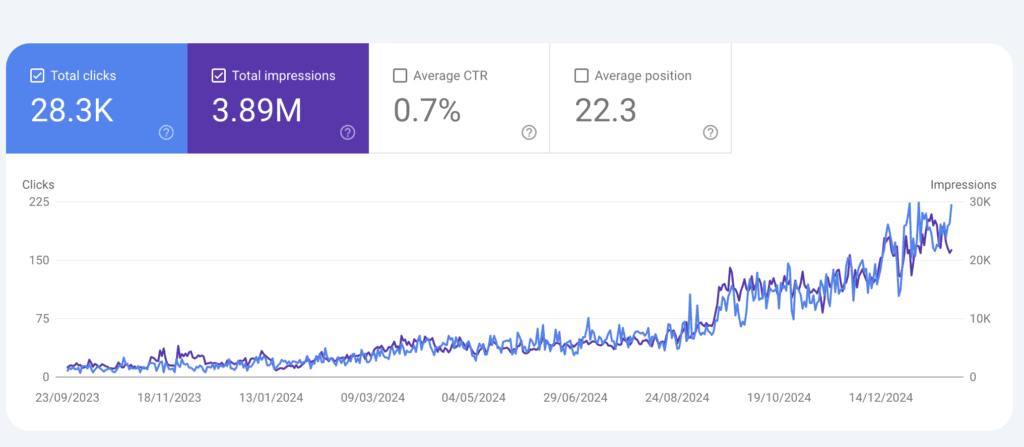
Use this data monthly to refine your content strategy, identify weak pages, and celebrate SEO wins with real numbers – not vague impressions.
Section 6: Common SEO Mistakes Aesthetic Clinics Make
Many clinics struggle to get results from SEO because of a few persistent mistakes. These aren’t just technical slip-ups – they’re often strategic missteps that limit visibility and waste time or budget.
1. Relying on “Conditions We Treat” Pages
While these pages might seem helpful for users, they rarely rank well and often compete with your main service pages. Worse still, they usually contain thin or duplicated content, which adds no real value.
Instead: focus on high-quality treatment pages that mention relevant conditions within the context of the service itself (e.g. how dermal fillers can treat volume loss or fine lines).
2. Keyword Stuffing
Repeating the same keyword multiple times across headings, paragraphs, and metadata doesn’t help your rankings – it makes the page unreadable and signals low-quality content to search engines.
Use keywords naturally and include variations: think about how your patients actually search, and write in a way that answers their intent, not just the algorithm.
3. Ignoring Metadata
Page titles and meta descriptions are still powerful ranking and click-through signals, yet many clinic websites either use defaults (like “Home” or “About”) or leave them blank.
Craft metadata for each page with a focus on clarity, keywords, and benefits. This alone can improve your click-through rate even if rankings stay the same.
4. No Internal Linking Strategy
Too many aesthetics websites operate in silos: blog posts don’t link to service pages, service pages don’t link to each other, and key pages are buried deep in the site structure.
Create a clear internal linking strategy. Every blog post should link to at least one service page, and your main pages should connect logically. This improves SEO and helps visitors find relevant content.
5. Ignoring Mobile Performance
Most aesthetics patients will visit your website on their phone. If your mobile site is slow, hard to navigate, or filled with oversized images, you’ll lose enquiries before they even see your content.
Run regular mobile performance checks (using tools like PageSpeed Insights) and prioritise usability. A fast, clean mobile site is no longer optional.
Section 7: Should You DIY or Hire an Agency?
At some point, every clinic asks the same question: do we do this ourselves, or should we outsource our SEO to an agency?
The answer depends on your goals, your budget, and your ability to consistently implement best practice. SEO isn’t overly complex, but it does require time, strategy, and technical understanding – all of which are often in short supply inside a busy aesthetics business.
When DIY Makes Sense
- You’re just starting out and need to control costs
- You’re comfortable learning the basics and using tools like GA4 and GSC
- You only need light SEO support: blog writing, metadata updates, or GBP maintenance
DIY is absolutely doable – but it needs structure. Use trusted resources, set time aside each month, and track your performance with proper tools. If you’re not seeing results after 6–12 months, it might be time to reassess.
When You Should Consider Outsourcing
- You’ve outgrown the DIY approach and don’t have time to keep up with changes
- Your current agency isn’t delivering results (and you’re not sure what they’re actually doing)
- You’ve launched a new clinic or website and need fast, strategic momentum
Good agencies will take time to understand your clinic, avoid shortcuts, and prioritise long-term growth over vanity metrics. Look for transparency, measurable goals, and proof of experience in your sector.
Red Flags to Watch For
- You don’t receive regular reports or clear explanations
- You’re paying for content, but nothing is ranking
- You’re locked into a long contract with no real visibility
SEO should be collaborative and data-driven. If you’re in the dark about what’s happening, it’s a problem.
Section 8: Final Thoughts
SEO for aesthetics clinics doesn’t need to be overwhelming, but it does need to be intentional. The clinics that succeed in search are the ones that invest in strategy, not shortcuts: they build useful content, optimise for local visibility, and focus on long-term growth.
Whether you’re managing SEO in-house, reviewing agency performance, or planning your first marketing push, the key is clarity. Understand what works, track what matters, and build a system you can scale.
If you’re serious about growing your clinic online, SEO should be a non-negotiable part of your marketing toolkit.
What Next?
- Download our Medical Aesthetics Marketing Playbook for more step-by-step SEO and content tips
- Need help? Book a free consultation and we’ll review your website and current SEO activity