Last Updated on February 24, 2026 by Jane Nriapia
Within medical aesthetics, a clear shift has taken place, both in the treatments clinics offer and in what patients actively seek.
Understanding this transformation requires looking not only at current trends but at the origins of non-surgical aesthetic medicine and the innovations that shaped it.
Throughout history, humans have sought to enhance their appearance using whatever tools and resources were available.
Early practices such as applying oils to the skin or using combs to groom hair have evolved into a global multi-billion-pound industry that now includes highly sophisticated aesthetic medical procedures.
The Roots of Modern Aesthetic Medicine
Modern aesthetic medicine is built on medical innovation. One of the most important breakthroughs was the invention of the hypodermic needle and syringe by Dublin-born physician Francis Rynd in 1844.
Rynd performed the first recorded subcutaneous injection, laying the foundation for injectable treatments as we know them today.
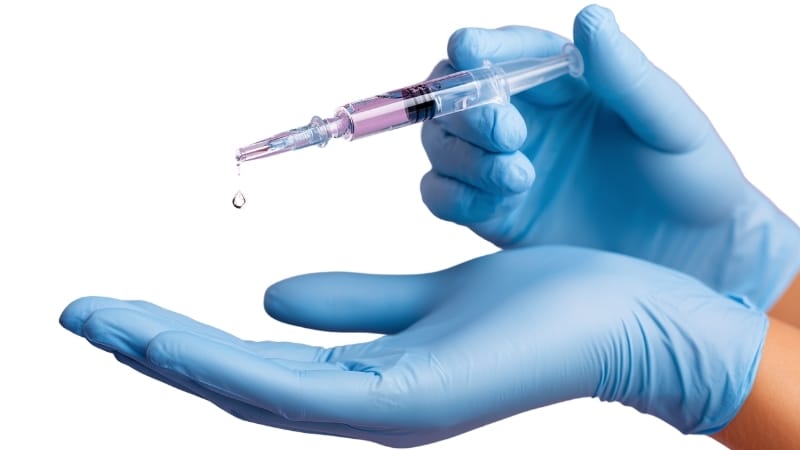
In 1893, Gustav Neuber (also known as Franz Neuber) pioneered autologous fat grafting to treat skin depressions and scarring, demonstrating early recognition that a patient’s own biological material could be used therapeutically for aesthetic improvement.
The First Injectable Aesthetic Treatments
By the early twentieth century, physicians were experimenting with injected substances such as paraffin to improve wrinkles, skin laxity, and facial contours.
Although innovative for their time, these approaches often produced complications, highlighting the importance of safety, regulation, and scientific validation in aesthetic medicine.
Silicone injections later emerged in the mid-twentieth century but were ultimately banned by the FDA after evidence showed migration and serious adverse effects.
In 1981, bovine collagen became the first FDA-approved cosmetic filler, marking the beginning of regulated injectable aesthetics.
Modern Neuromodulators and Fillers
Ophthalmologist Dr Jean Carruthers first observed the wrinkle-reducing effects of botulinum toxin while treating patients with blepharospasm.
Together with her dermatologist husband, she initiated the first clinical study in 1987 investigating its cosmetic applications.
That observation led to Botox being one of the most widely performed aesthetic procedures worldwide.
Today, botulinum toxin and hyaluronic acid dermal fillers remain core treatments for patients seeking facial rejuvenation. However, as the history of aesthetic medicine demonstrates, innovation never stands still. New technologies, techniques, and regenerative approaches continue to reshape the industry.
UK Search Demand for Injectable Treatments
Clinics now have access to a broader range of injectable treatments than ever before. To understand how patient interest is evolving, search data provides valuable insight into demand patterns, emerging treatments, and shifting preferences.
To visualise how search demand for regenerative injectable treatments has evolved, I analysed UK Google Trends data from 2021–2026:
It is essential to distinguish between general curiosity and clinical intent. Our analysis identifies a ‘public awareness crossover’ where Polynucleotides have captured the cultural zeitgeist, even though Dermal Fillers remains the established ‘gold standard’ for patients searching with a specific medical or corrective outcome in mind.
For this analysis, I used Semrush, one of the world’s leading SEO platforms, alongside Google Trends data.
These tools allow us to examine real-world search behaviour across Google Search, Shopping, and YouTube to identify which treatments are gaining traction and which are plateauing.
Strategic interpretation of search behaviour is essential in healthcare and medical aesthetics, where visibility is closely tied to trust, credibility, and expertise.
This is something I explored in detail in my Aesthetics Journal feature on SEO strategy in regulated healthcare sectors.
The Rise of Regenerative Treatments
Public awareness of PRP accelerated dramatically in March 2013 after Kim Kardashian underwent a ‘Vampire Facial’ treatment on an episode of Kourtney and Kim Take Miami.
Following the broadcast, Google Trends data shows a sharp spike in search demand for the treatment, illustrating how media exposure can rapidly influence patient interest.
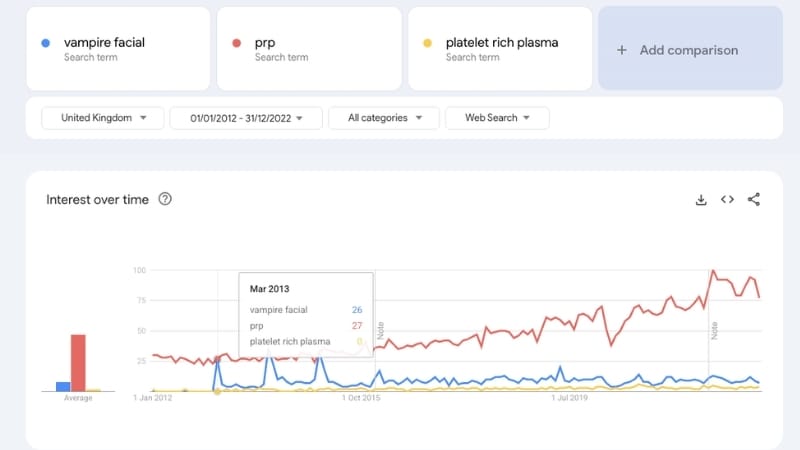
While PRP had existed clinically long before this point, the episode marked a turning point in public awareness
This demonstrates how cultural visibility can act as a catalyst for treatment adoption, even when the underlying procedure is not new.
Search trend platforms are powerful strategic tools for clinics. They can reveal emerging topics before they become saturated, allowing early adopters to build authority and capture search demand ahead of competitors.
This is the same principle that underpins effective medical aesthetics SEO, where understanding search behaviour allows clinics to align their content strategy with real patient demand.
Polynucleotides and Early-Mover Advantage
Polynucleotide treatments provide a clear example of how timing influences online visibility. When this treatment first entered the market, clinics that published educational content early positioned themselves to benefit from rising search demand.
Case Study: Publishing Early and Capturing Demand
When polynucleotides first entered the aesthetics market, I was working within a clinic and began publishing educational content about the treatment immediately. Reviewing the clinic’s blog archive shows that the first article I wrote on the subject was published on 4 August 2023.
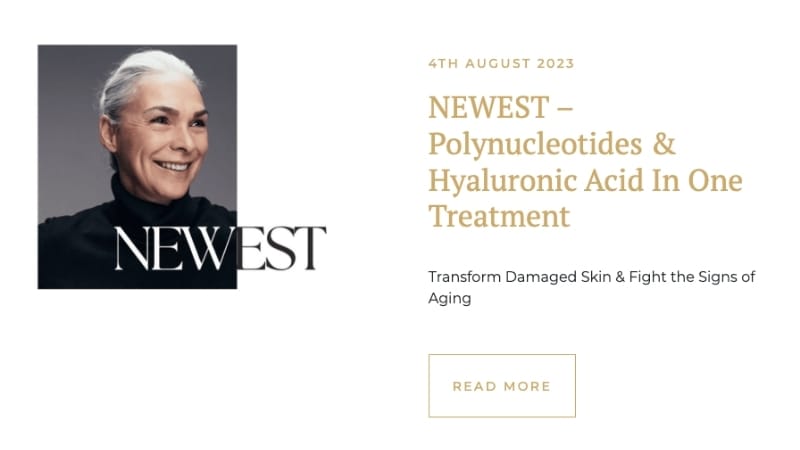
Search trend data indicates that public interest began rising shortly afterwards. This timing illustrates a key principle in aesthetics marketing: clinics that publish high-quality educational content early in a treatment’s lifecycle often secure a visibility advantage that is difficult for competitors to replicate later.
Changing Demand: Polynucleotides vs Dermal Fillers
Trend comparisons reveal a crossover point in early 2024 where search demand for polynucleotides accelerated while dermal filler searches remained relatively stable.
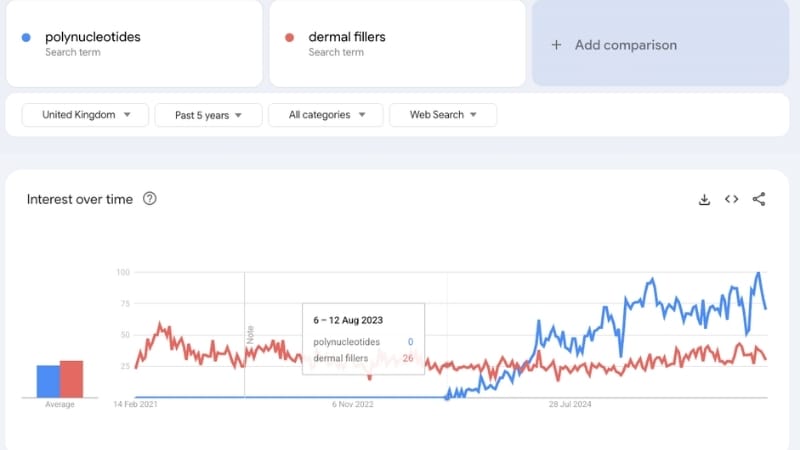
Current keyword data indicates approximately 18,100 monthly searches for polynucleotides compared with around 8,100 for dermal fillers.

This does not mean dermal fillers are declining in clinical relevance. Instead, it suggests patient curiosity is expanding toward regenerative approaches, particularly those perceived as improving skin quality rather than altering facial structure.
Polynucleotides vs Exosomes
Exosomes have generated lower but steadily increasing search interest over the past five years. Like PRP, they are used across multiple medical disciplines, which contributes to baseline search demand.
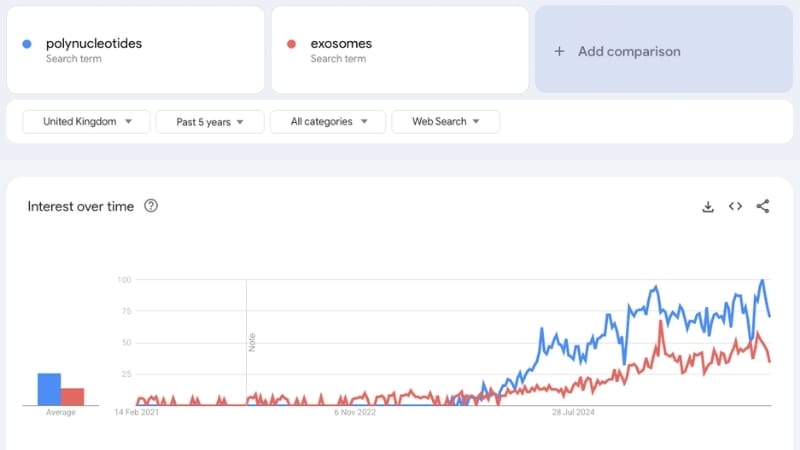
Keyword data currently shows roughly 18,100 monthly searches for polynucleotides compared with about 6,600 for exosomes. The trend trajectory indicates that while exosomes are gaining awareness, polynucleotides have experienced faster growth in public interest.

Clinics that publish comprehensive educational content on emerging treatments often see corresponding increases in visibility, website traffic, and patient enquiries, particularly when that content sits on a strategically structured aesthetics clinic website designed to support search performance.
Biostimulators and Regenerative Fillers
The regenerative injectable category also includes collagen-stimulating products such as Sculptra, Radiesse, and HArmonyCa. When comparing search demand between these brands, the data reveals a striking disparity.
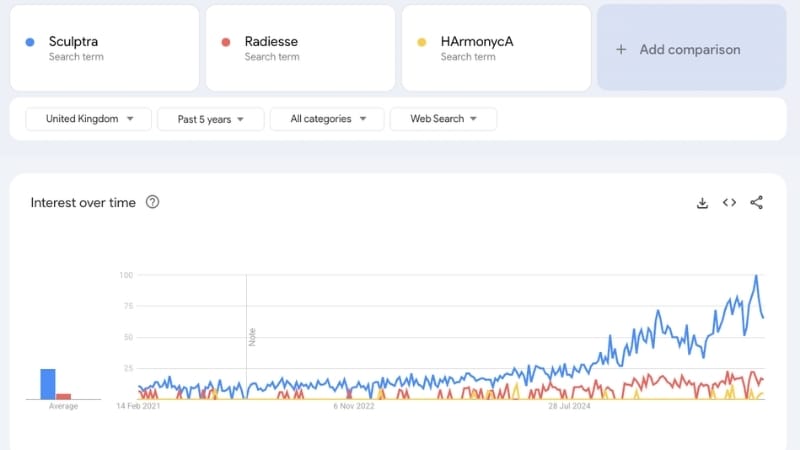
Search volumes show:
- Sculptra: ~12,100 monthly UK searches
- Radiesse: ~2,400 monthly searches
- HArmonyCa: ~720 monthly searches

At first glance, many clinicians assume these brands generate similar levels of patient interest. However, the search data tells a very different story.
Sculptra is not just ahead, it is dramatically ahead, receiving several times the search demand of its competitors combined.
This kind of insight is precisely why data analysis matters. What feels like a competitive market at clinic level may, in reality, be dominated by one brand in public awareness.
For clinics, that gap represents both opportunity and strategy: high search demand signals strong patient recognition, but it may also indicate increased competition in areas where providers have already adopted the treatment.
What This Means for Clinics Choosing Treatments
When deciding which new injectable treatments to introduce, clinical evidence and patient outcomes must always be the primary consideration.
However, search data adds another decision-making layer that many clinics overlook.
Analysing demand trends can help clinics:
- identify treatments patients are actively researching
- anticipate rising trends before competitors adopt them
- align service offerings with real-world interest
- prioritise treatments with strong awareness but low local competition
In short, combining clinical judgement with data analysis allows clinics to make more informed, strategic decisions about growth.
The Future of Injectable Aesthetics
If the history of aesthetic medicine shows anything, it is that the industry evolves continuously. Treatments that dominate one decade may be replaced by entirely new approaches in the next.
Search behaviour already indicates a growing interest in regenerative and bio-stimulatory treatments, suggesting that patient priorities are shifting toward long-term skin quality and cellular-level improvement rather than short-term cosmetic correction alone.
This shift is also reflected in emerging keyword trends within regenerative aesthetics.
Clinics that monitor these signals and act early are best positioned to lead rather than follow industry change.
Why Timing Matters More Than Volume
In aesthetics marketing, success is rarely determined by who publishes the most content.
More often, it is determined by who publishes the right content at the right time. Clinics that recognise emerging trends early and act on them strategically position themselves to attract attention, authority, and patient demand long before competitors enter the space.